
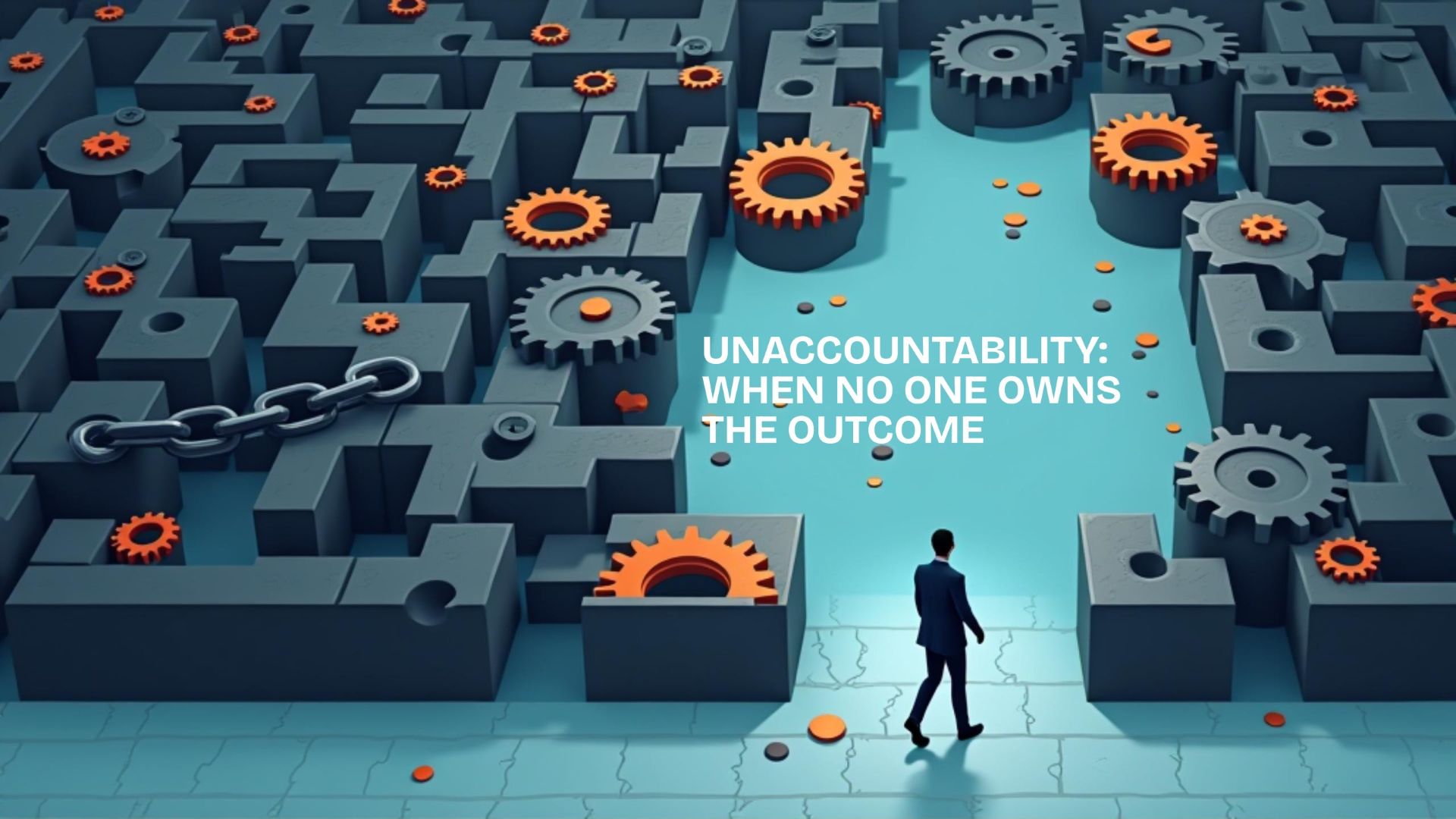
Leadership today is a juggling act; you are expected to hit KPIs, align with an evolving strategy, drive change, support your team’s wellbeing, and still find time to answer all the email queries.
If your organisation shows the following pattern of behaviour:
- Everyone is technically doing their job.
- Yet no one feels ownership in their role.
- Unresolved problems bounce between roles or systems.
- Real accountability vanishes into complexity.
- Staff wellbeing quietly erodes.
I would highly recommend reading Dan Davies’ “The Unaccountability Machine.” 2024. The book explores how since World War II, systems have evolved in ways that obscure responsibility and make it nearly impossible to know who’s accountable when things go wrong.
Davies uses the concept of the ‘accountability sink’ – a policy or set of rules that prevent individuals from making or changing decisions and thus being accountable for them.
He writes: “For an accountability sink to function, it has to break a link; it has to stop feedback from the person affected by the decision from affecting the operation of the system. The decision has to be fully determined by the policy, which means that it cannot be affected by any information that wasn’t anticipated.”
Once you start to look for accountability sinks, you will see them everywhere, e.g., an airline cancelling your flight, a lost parcel, a failed product return, or a mismanaged system implementation.
The accountability sink is like a Black Box where decisions go in, outcomes come out, but it is nearly impossible to see who made which choice or why. Whether it’s a rulebook, a best practice, or a complex IT system, these sinks make it nearly impossible to trace errors or fix what caused them.
Essentially, an accountability sink breaks the connection between those who make decisions and the individuals affected by them. This breakdown prevents crucial feedback from being shared when a system malfunctions. The ultimate result, Davies argues, is a state of “protocol politics,” where no one is truly in charge or held accountable.
Decision-makers can evade responsibility for their organisational actions, while consumers or employees endure the most of these poor management decisions.
Stafford Beer: Viable System Model
Davies explains how the British management guru Stafford Beer developed a “Viable System Model” 1972, to create a picture of how an organisation works. The viable system consists of five interlinked systems that work together to enable an organisation to fulfil its purpose while adapting to a constantly changing environment. Here is a brief breakdown of the five systems:
System 1 – Operations. This is the part of the organisation that does the actual work i.e. sales, marketing, human resources, finance, IT, legal, and manufacturing. Each operational unit must be autonomous enough to respond to its own local environment yet still align with the organisational strategy.
System 2 – Regulation. This system ensures smooth coordination between operational areas in System 1, e.g. scheduling, shared resources, and communication to ensure that chaos does not erupt when priorities clash.
System 3 – Integration is the first level of management and ensures System 1 & 2 are working smoothly every day. Both System 2 & 3 look like they are doing the same thing, but the difference is that System 2 is all about preventing clashes and managing conflict, while System 3 is concerned with achieving a purpose.
System 4 – Intelligence function is the part of the system dealing with information from those parts of the environment that are not in direct contact with System 1 and is looking towards the future to predict what changes are happening in the global landscape that the organisation will have to adapt to. System 4 is set up to gather external information and guide System 3 in adapting to future changes.
System 5 – Identity function is making the decisions that will determine what an organisation does and what its purpose is. In today’s constantly changing environment, an organisation needs to know what to focus on and what to ignore so that it can be successful.
The Viable System Model will help you decide whether a given proposal is viable. It will tell you what to consider, whether it addresses the right problems, and the system’s ability to withstand or survive organisational change. However, the Viable System Model will not generate ideas; this part must be done by the people in charge of the systems.
The problem with the Viable System Model is that decision-making takes time and, at every stage information has to be collected, a decision has to be made to escalate the problem, and then the problem has to be communicated. Sometimes, issues arrive at the lowest levels of an organisation, which are both significant in terms of required resources and demand an immediate response.
Implications for Leaders
Most organisations don’t build unaccountability machines deliberately; they form over time, through a thousand small decisions that prioritise procedure over people, technology over trust, and performance metrics over meaning.
Here is what it does to your people:
- They are held responsible for outcomes they cannot control.
- They lose autonomy as layers of approval grow.
- They stop speaking up because no one listens.
- They become burnt out from the mismatch between expectations and influence.
When organisations grow and change without recalibrating the People, Process, and Technology (PPT) alignment, it will create work cultures that exhaust, frustrate, and eventually good people will leave.
People: Accountability Without Authority
People are expected to “own” outcomes while navigating outdated systems, shifting expectations, and limited authority.
This happens when:
- Staff are evaluated on KPIs where they have little to no power to influence.
- Decisions are made without input from the people affected.
- Feedback loops exist on paper, but not in practice.
People will usually disengage when they feel unheard and their workload is unmanageable.
Process: When the System Becomes the Problem
Processes often begin with good intent, but over time the system procedures and policies become disconnected, causing a shift from enabling work to fixing issues. Teams spend more time explaining problems than solving them.
The impacts when this happens are unmanageable workloads, people become frustrated, and the “why bother” mindset emerges. Even high performers become weary or indifferent toward the organisation strategy.
Technology: Complexity Over Clarity
When technology is introduced to an organisation without proper design and integration, it can create extra work and extra stress.
The effects of poor design and integration include:
- Systems are chosen with no user consultation, and this leads to staff resistance.
- People working with the new system will build workarounds to complete their work.
- Technology changes instead of streamlining, can add layers to work instead of removing them.
When people believe the system is working against them, they will become cynical, disengaged, or quietly non-compliant.
Moving Forward
“Systems don’t have motivations, so they don’t have hidden motivations. If the system consistently produces a particular outcome, then that’s its purpose. But on the other hand, systems don’t make mistakes. Just as it’s impossible to get lost if you don’t know where you’re going, a decision-making system does what it does and then either lives with the consequences or dies of them.” (The Unaccountability Machine, Author’s Notes ix)
Dan Davies “The Unaccountability Machine” helps us understand how systems become unaccountable, not out of malice but by design. He leaves us with a warning that the world is not going to get simpler; our challenge as leaders is to become better at navigating complexity, especially when accountability is unclear.
The cost of ignoring the unaccountability issue will foster a culture of ‘no responsibility,’ and instead of addressing issues, leaders may engage in avoiding responsibility for mistakes, blaming other departments or external factors for failures, which prevents the valuable lesson of learning from mistakes.
A culture of unaccountability can have significant effects on an organisation, such as good people leaving, morale declining, innovation stalling, and trust eroding.
Moving forward, leaders should acknowledge the complexity of the organisation system and focus on creating organisations where systems are transparent, feedback is welcome, and people’s contributions are connected to the organisation strategy. This type of culture will give people clarity, authority and support them when things go wrong.
The goal is not to control every outcome but to build systems where responsibility is shared, mistakes are safe to own, and learning opportunities are continuous. In a world that won’t stop getting more complex, leaders must become architects of clarity in both strategy and accountability. Because when no one owns the outcome, everyone pays the price.