

“The people must have ownership in the vision. They need to be enabled to accomplish it. If there is one investment you should make, it is in people.”
— Modesta Lilian Mbughuni, Executive Leadership Coach
In a world where organisations are constantly adapting to economic pressure, digital transformation, and rising employee expectations, one constant that remains is that people are an organisation’s most valuable resource.
Yet many leadership teams still operate as though finance and well-being are separate priorities, in that a finance measure is a key performance indicator (KPI), and a well-being measure is staff surveys. This disconnect is now costing organisations in terms of staff disengagement, burnout, turnover, and productivity.
The Traditional Divide: Finance Vs. Wellbeing
In many organisations, finance and wellbeing exist but operate as separate functions.
- Finance is responsible for budgets, cash flow, forecasts, and financial sustainability.
- Well-being is usually managed by HR and often perceived as a soft benefit, i.e., an advantage or reward offered to an employee that is not financial.
This mindset needs to change, as when employees experience stress, burnout, disengagement, or financial hardship, these factors will, in turn, affect an organisation’s success due to higher absenteeism rates, increased staff turnover, and decreased productivity.
Wellbeing should now be incorporated in the financial strategy and not viewed as a feel-good initiative in an organisation’s overall strategic objectives and goals. When people feel financially secure and psychologically safe, they are more:
- Engaged
- Creative
- Loyal
- Productive
Leading Through Uncertainty: The Case for Resilience
In 2017, Professor David Denyer (Cranfield University) researched a resilience model for navigating complexity and uncertainty in organisations. Organisational Resilience is defined as “the ability of an organisation to anticipate, prepare for, respond and adapt to incremental change and sudden disruptions in order to survive and prosper” BS 65000 Organisational Resilience 2014.
Research has found that resilient organisations have systems and procedures in place to restore order in the face of anticipated threats or disruptions to their critical functions and processes. Leaders of resilient organisations view threats as opportunities and take measured risks to ensure that the organisation prospers in the long term.
Denyer’s research found that Organisational Resilience differs on two core dimensions:
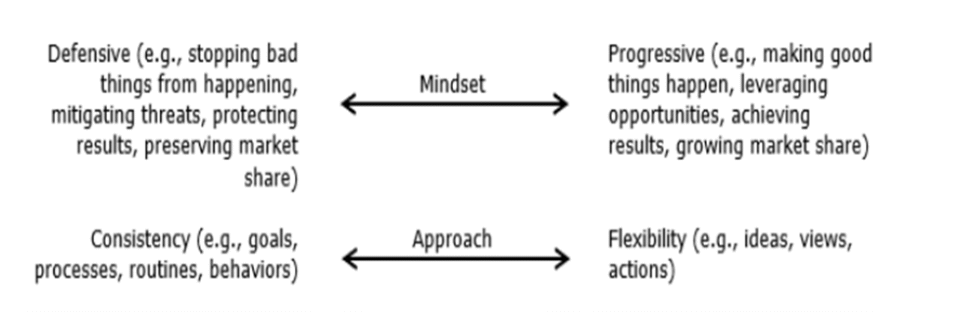
Leaders need to manage the tensions between both defensive & progressive, and consistent & flexible. These two dimensions form an integral part of a framework, which is named the Strategic Tension Quadrant Model (Figure below)
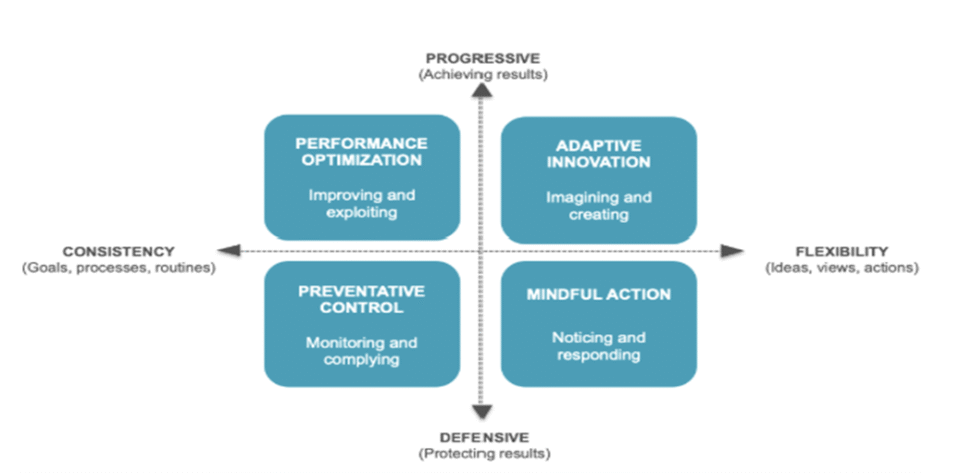
This model highlights the four common strategies for achieving organisational resilience.
Senior Leaders need to manage tensions between these four strategies to ensure that an organisation is truly resilient. By applying these strategies, finance leaders can strengthen both financial and human systems:
o Preventative Control (Defensive Consistency): Finance plays a key role in ensuring the organisation can adapt to unforeseen challenges. The Preventative Control approach involves proactively funding essential initiatives such as business continuity plans, workforce wellbeing policies, and compliance with safety and industry standards. Organisations that invest in these protective measures can significantly reduce the negative impacts of issues such as burnout, declining mental health, and system failures.
o Mindful Action (Defensive Flexibility): Finance can foster Mindful Actions by budgeting for leadership development, wellbeing awareness programs, and responsive support mechanisms. When employees are equipped with the correct training and resources, they feel competent and prepared to act effectively when a challenge arises. This proactive financial strategy ensures that employees are ready to navigate change with confidence and skill.
o Performance Optimisation (Progressive Consistency): Finance can actively support continuous improvement through Performance Optimisation. This could involve allocating resources to foster smarter processes, develop clearer metrics, and implement productivity-enhancing tools. Finance can directly contribute to a healthier and more productive workforce by reducing inefficiencies that often lead to stress and frustration and by building systems that help people succeed in performing their roles. Strong leadership accountability is key in this domain to ensure consistent progress.
o Adaptive Innovation (Progressive Flexibility): When finance teams are future-oriented, they are more open to embracing Adaptive Innovation by creating space for experimentation, creativity, and inclusive problem-solving. This could include funding pilot programs for modern technologies or investing in mental health initiatives. This adaptive finance approach will unlock the organisation’s creative capacity by recognising that people will openly contribute when they are empowered to assess innovative ideas and push boundaries.
By strategically aligning financial planning with these four approaches, finance leaders can help cultivate a healthy, future-ready workforce. Denyer’s model serves as a powerful reminder: resilience is not an inherent trait, but a dynamic system that finance can help to shape in an organisation’s strategy.
Real-World Case Studies: The Impact of Integrating Finance and Wellbeing
o SAP: Embedding Wellbeing into Corporate Strategy
SAP, a global leader in enterprise software, recognised that high performance was coming at a human cost, staff burnout and disengagement increased, and productivity decreased. SAP made a strategic decision to integrate well-being into the core business strategy. By doing this, SAP achieved measurable returns on investment through higher employee engagement, reduced turnover, and enhanced productivity.
o Medibank: Embracing the Four-Day Work Week
In 2023, Australian health insurer Medibank conducted a six-month trial of a four-day workweek, maintaining full pay for employees. The results were significant: employees reported improved work-life balance, better psychological well-being, and maintained productivity levels. The success of this trial led Medibank to expand the program, demonstrating that innovative work arrangements can enhance employee wellbeing without compromising business performance. Medibank’s experience underscores the potential benefits of rethinking traditional work structures. By aligning employee well-being with business objectives, the company has set a precedent that could inspire similar initiatives across various industries.
o South Cambridgeshire District Council: Public Sector Innovation
In January 2023, South Cambridgeshire District Council in the UK initiated the first local government four-day workweek trial. The primary goal of the trial was to enhance employee well-being and address challenges with recruitment and retention. Under the South Cambridgeshire trial, which began in January 2023 and ran to April 2024, staff were expected to carry out 100% of their work in 80% of the time for 100% of the pay. The full trial cut staff turnover by 39%, and scores for employees’ physical and mental health, motivation, and commitment improved, the study showed.
Strategies for Leaders: Bridging Finance and Wellbeing
To harness the full potential of integrating finance and wellbeing, leaders should consider the following strategies:
o Foster Cross-Functional Collaboration
Break down silos by encouraging regular collaboration between Finance and HR teams. Encourage both to be involved in the design of wellbeing initiatives that are financially sustainable and aligned with organisational goals.
o Invest in Financial Wellbeing Programs
Implement programs that support employees’ financial health, such as educational resources and personal finance coaching. Organisations that address employee financial stress can lead to increased employee satisfaction and retention.
o Redefine Success Metrics
Organisations should include non-financial metrics such as employee engagement, turnover rates, and well-being scores, and move beyond traditional financial metrics. By incorporating non-financial metrics into strategic planning should enable an organisation to capture a holistic view of its performance and make more informed strategic decisions.
o Innovate Work Structures
Organisations should explore flexible work arrangements, like the four-day workweek, to enhance employee satisfaction and productivity.
o Rethink ROI
Organisations usually focus on Return on Investment (ROI), but it may be beneficial to change the focus to Return on Individual by tracking the following: –
- The experience people have at work.
- The actual cost of ignoring burnout within the organisation.
- If well-being is integrated into the strategic objectives, what impact would this have on the organisation?
o Lead By Example
Ensure the finance team receives support from leadership, since a culture of wellbeing must permeate from all levels of an organisation to be effective.
By embracing these strategies, organisations can create a synergistic relationship between finance and well-being, enabling both individuals and organisations to thrive.
At CLIOBAN Consultancy, we help organisations link finance and wellbeing, so both people and organisations thrive. If you’re seeking support or a fresh perspective, please feel free to connect with us at info@cliobanconsultancy.com.au.